Teacher Resources
Formative Assessments and Rubrics
View an example formative assessment document, Middle School Formative Assessment Tasks Algorithms, for the Algorithms standard.
The goal of standards-aligned formative assessments is to support teachers in gauging their students’ understanding of standards and identifying particular challenges students encounter with respect to the standard. Teachers are expected to create or select assessment tasks that cover critical aspects of the standard, administer those assessments to students, apply rubrics to analyze and interpret student work, and then adjust instruction based on the results of the assessments.
We have developed a document for each of our five focal standards to support CS teachers in using formative assessments. Each document includes the following three components:
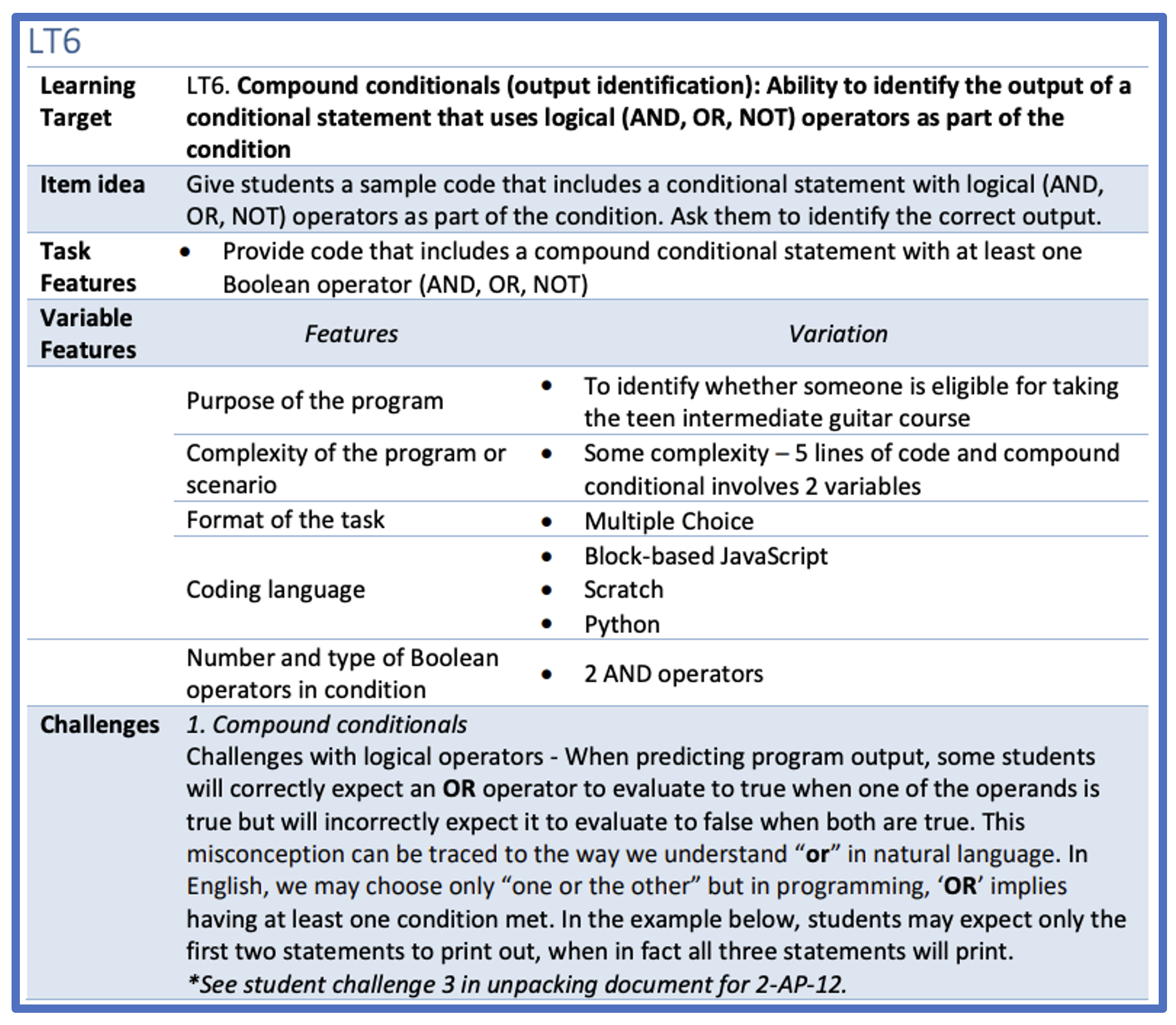
- Assessment Design Templates to help teachers create new assessment tasks in any programming language or modify provided assessment examples. These templates detail the decisions we made when designing our example assessment tasks, and serve as a blueprint for developing similar tasks in alternate formats, contexts, and programming languages. For each learning target under a specific standard, a template provides information about the types of assessment tasks that are appropriate for the learning target, features that every such task must have, ways in which such tasks can vary, and types of student challenges such tasks should try to identify. The figure below shows an example of a template for a learning target aligned with the control structures standard.
- Formative Assessment Tasks aligned with different learning targets and using different task formats. We have developed sample tasks for each standard using the assessment design templates. These tasks demonstrate how features from the design template can be translated into tasks. The tasks are designed to elicit information about how well students understand the learning target(s). Tasks are written using a programming language such as Scratch, Python, or JavaScript, or using pseudocode, or sometimes in plain English.
- Rubrics to identify student understanding and challenges. Our formative assessment tasks include two types of rubrics: Response Category (RC) and Indicated Challenges (IC). Each task has either an RC-type rubric or an IC-type rubric. The following sections describe the difference between these two rubrics.
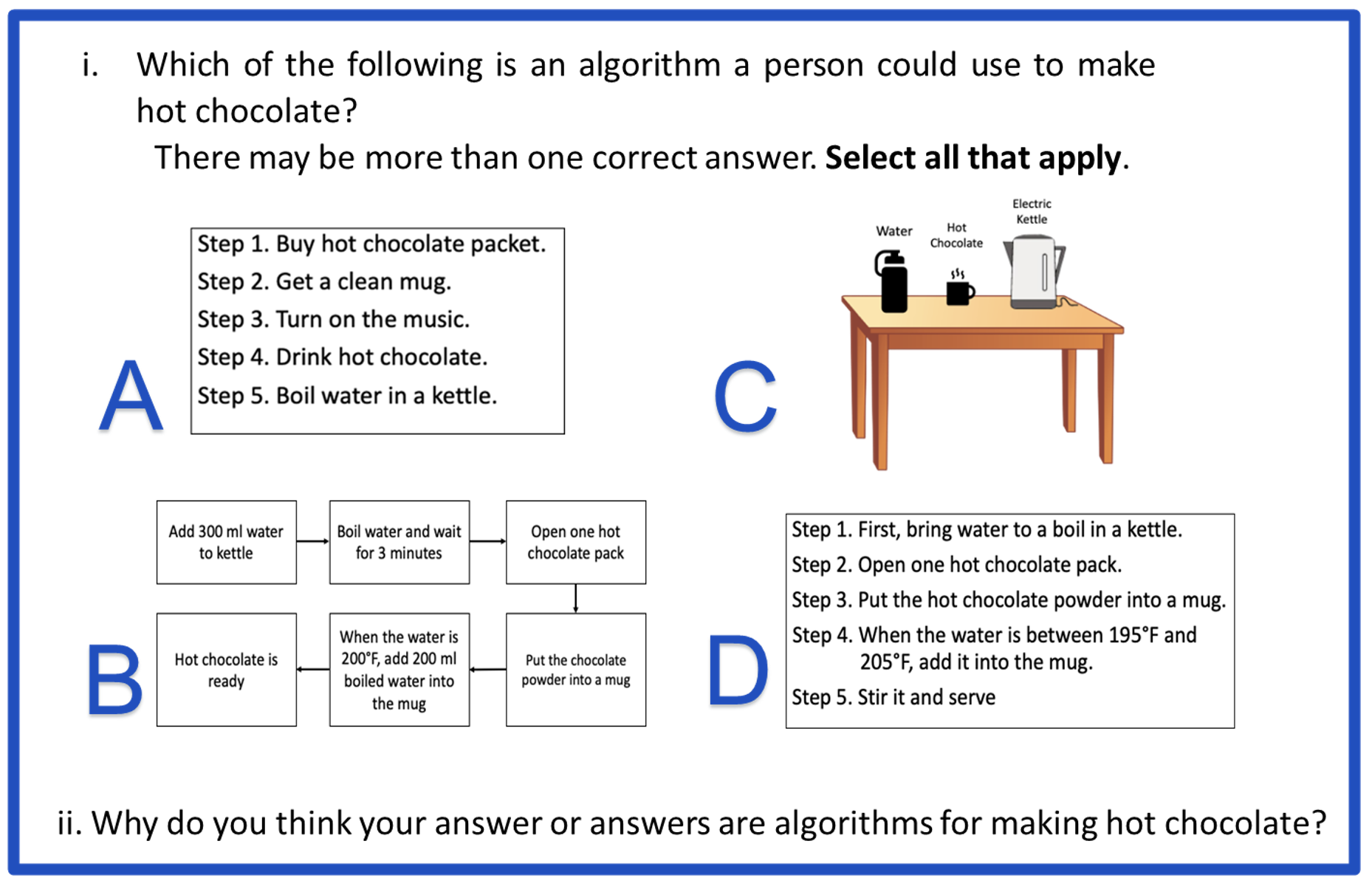
Below is an example of a formative assessment task for the Algorithms standard, targeting students’ understanding of what an algorithm is.
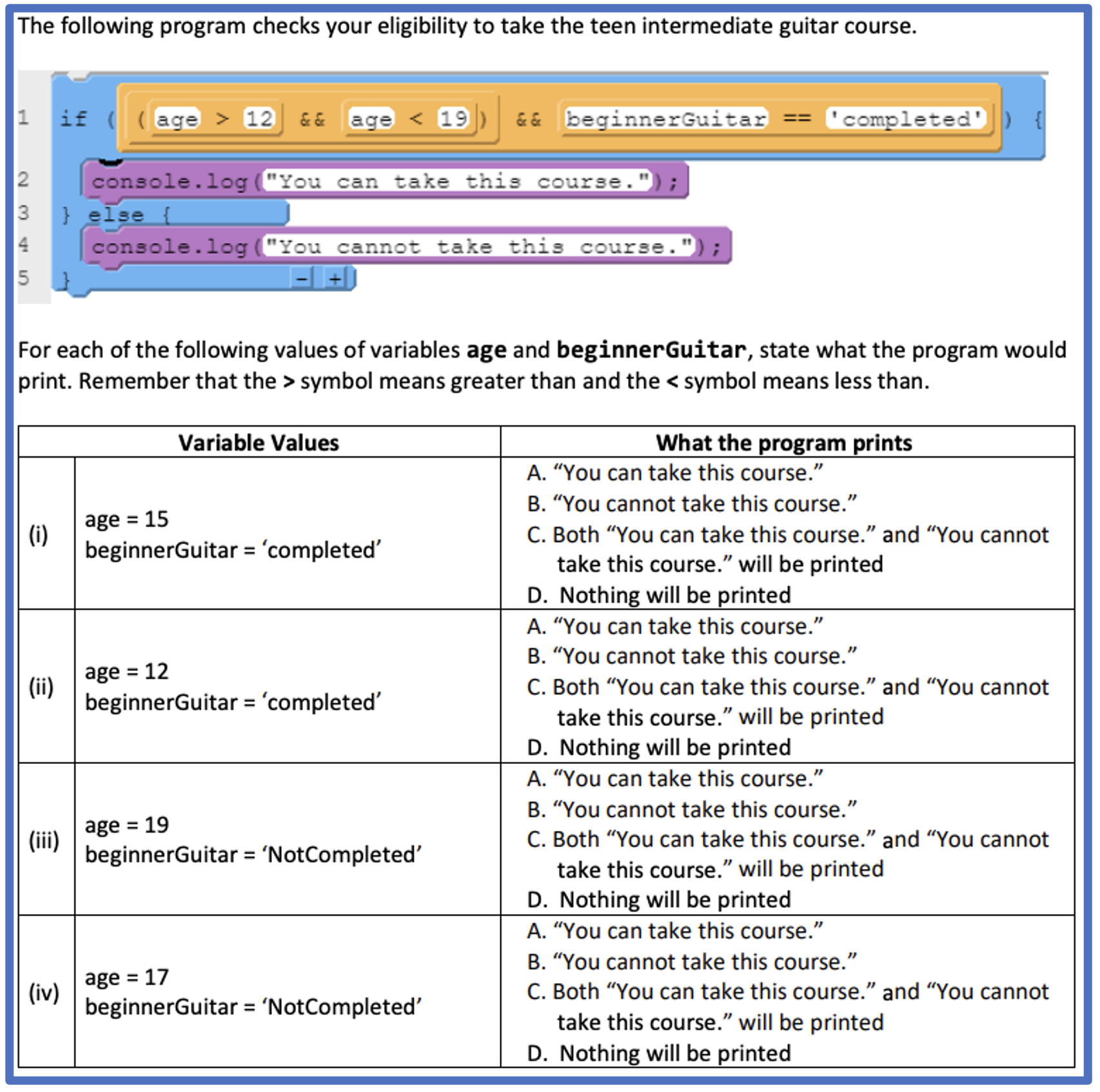
Below is another example of a formative assessment task for the combined control structures standard, targeting students’ ability to identify the output of a conditional statement that uses logical (AND, OR, NOT) operators as part of the condition.
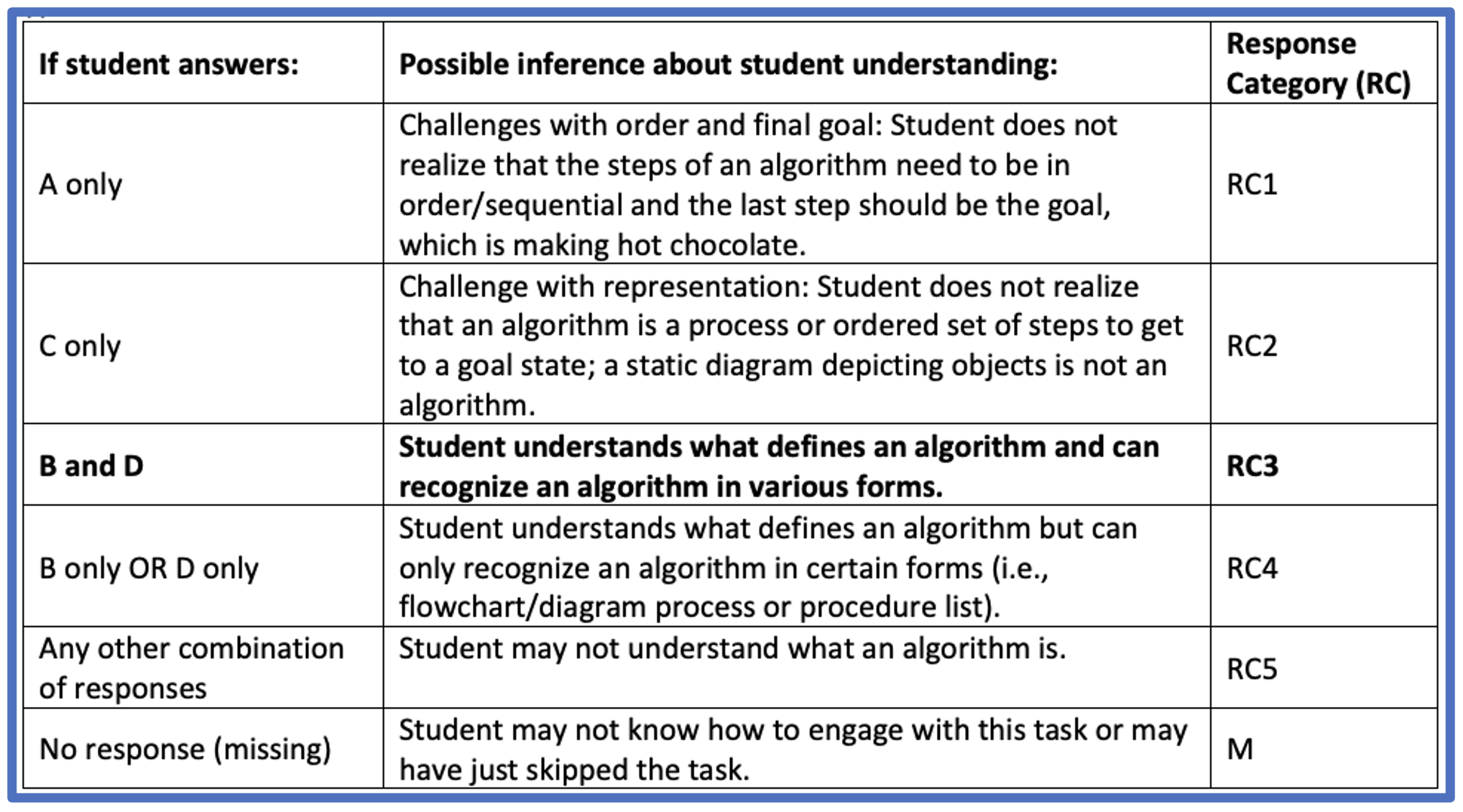
Response Category (RC) rubrics: The goal of the RC rubrics is to group students into different categories based on their responses so that the teacher can follow up with different categories of students in different ways. Each response category is associated with a specific challenge or set of challenges that students typically exhibit. Teachers only need to choose ONE response category for each student for each task. The figure below serves as an example of the RC rubric for a task assessing students’ understanding of algorithms.
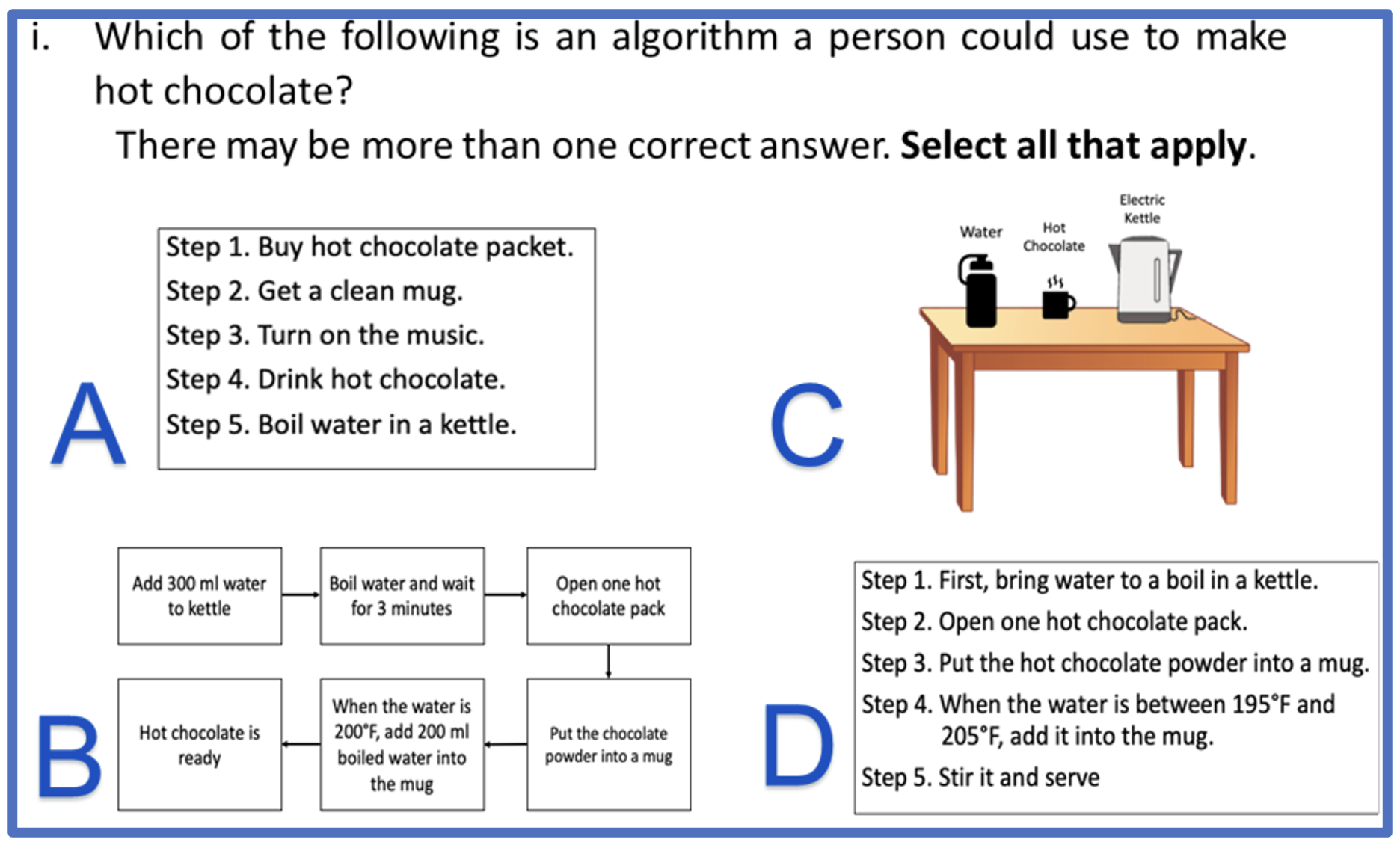
The rubric for this task is shown below and comprises five RCs.
Indicated Challenges (IC) rubrics: In some cases, tasks may elicit multiple challenges. IC rubrics are more appropriate in these cases as each rubric category is associated with a specific challenge and teachers can choose more than one IC category for each student. This allows teachers to see the different combinations of challenges their students are facing. Teachers can select ALL IC categories that apply for a student; if no IC category applies for a student, we can conclude that the student is able to successfully engage with the learning target. The figure below serves as an example of an IC rubric for a task assessing students’ ability to choose meaningful yet concise variable names.
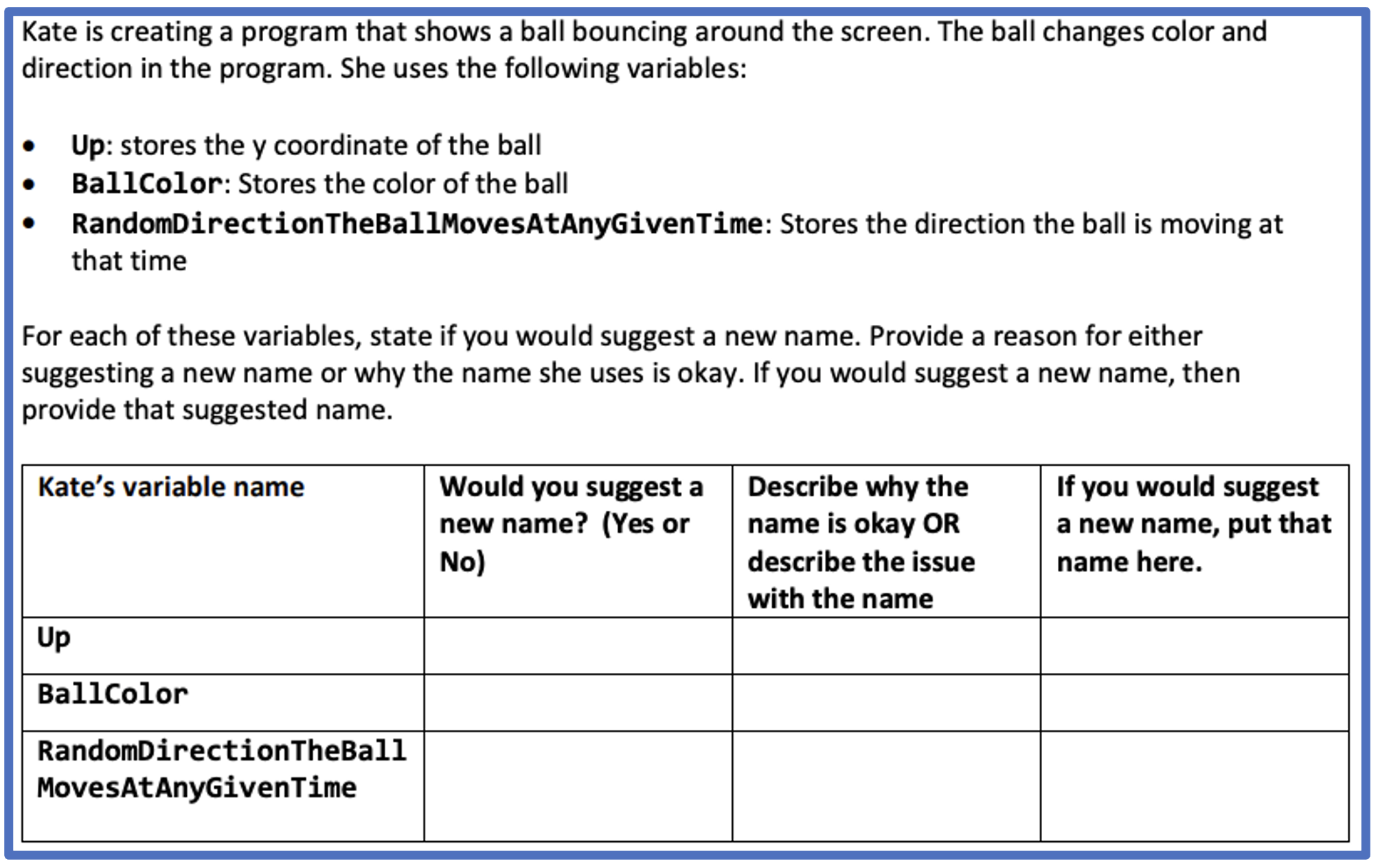
The rubric for this task is shown below and comprises five ICs. If a student’s response were rated as “IC 4” and “IC 5,” the student might have displayed two challenges in choosing meaningful yet concise variable names. The student might not understand what makes a good variable name and how to come up with appropriate variable names.
